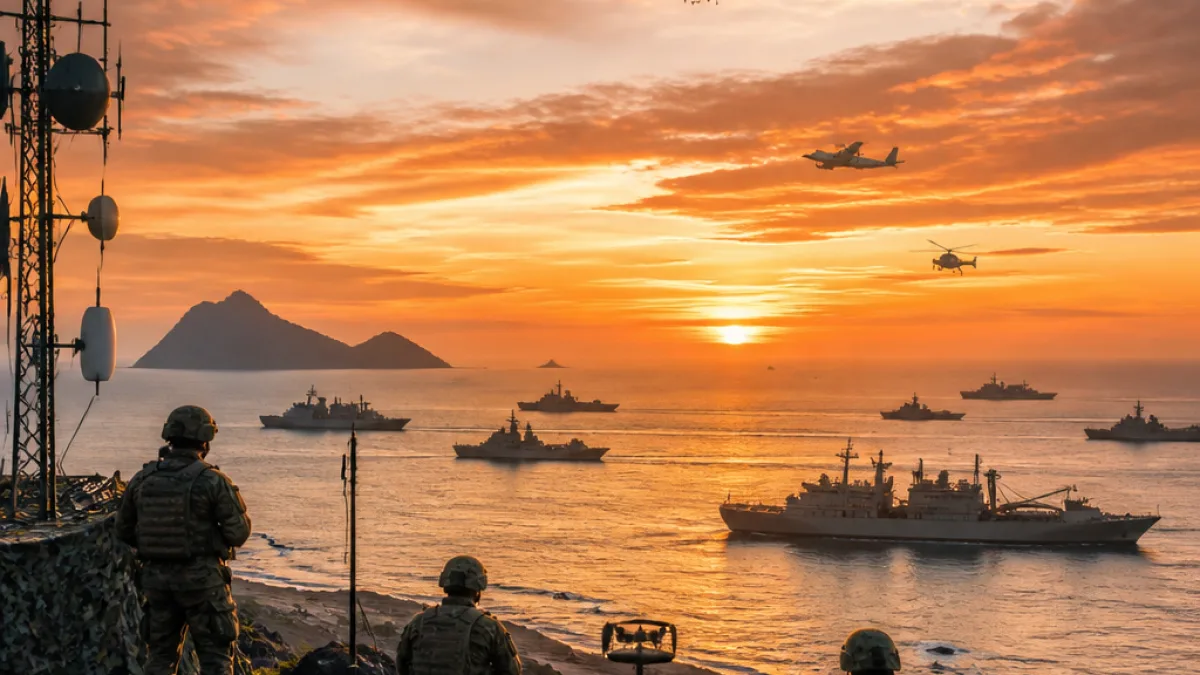
The largest joint Japan–United States military exercise in the two countries’ history, Keen Sword 27, is under way in southern Japan and adjacent waters and will run through 29 October, Japanese and US officials say. The drills involve a substantial concentration of forces and systems as Japan and the United States rehearse defence of the south‑west island chain stretching towards Taiwan.
Scale and focus of the exercise
Organisers say the exercise includes at least 45,000 Japanese service personnel and at least 11,000 US troops — a combined total of about 56,000 service members — along with ships, aircraft and ground formations. Key activity is concentrated around Japan’s remote islands such as Yonaguni and Ishigaki, with a focus on defending those islands and maintaining sea‑lane security.
| Participant | Approximate strength |
|---|---|
| Japan | 45,000 |
| United States | 11,000 |
What the partners say
Tokyo and Washington have framed the drills as defensive preparedness. According to official statements cited in reporting, the exercise is intended to practise response to crises affecting Japan’s remote islands and to preserve maritime lines of communication.
“This is defensive training: Practice for a crisis, practice for keeping sea‑lanes open and practice for responding if Japan’s remote islands come under threat,” the United States and Japan said.
Chinese activity near the exercise areas
Beijing has not remained passive. Japanese authorities reported Chinese spy‑drones, reconnaissance aircraft and intelligence‑gathering ships operating near areas used for the drills. Japan scrambled fighter aircraft after Chinese drones and a reconnaissance plane transited the Miyako Strait and entered the Pacific, the reports said. Chinese warships, including vessels that could support an aircraft‑carrier, were also observed close to exercise areas.
Reporting adds that American and Japanese forces have, for the first time in these drills, positioned advanced anti‑ship missile systems and long‑range Japanese missiles on Yonaguni and Ishigaki, together with mobile launchers intended to delay or deter hostile approaches to the islands.
- Training scope: combined maritime, air and ground operations, logistics and island defence scenarios.
- Geography: south‑west Japanese island chain, Yonaguni and Ishigaki, Miyako Strait approaches to the Pacific.
- Opposition activity: Chinese unmanned aerial systems, reconnaissance flights and surface taskings shadowing the exercises.
Regional context
Keen Sword 27 brings together substantial US and Japanese combat, logistics and coastal‑defence capabilities in areas close to Taiwan. Japanese and US officials say the focus is defensive and aimed at contingency response and protection of maritime routes. Chinese movements — described in reporting as intelligence collection and shadowing — underline the contestation that accompanies large, high‑visibility exercises in the Indo‑Pacific.
All operational claims about Chinese activity and the purpose of deployments are reported as statements by the nations involved.