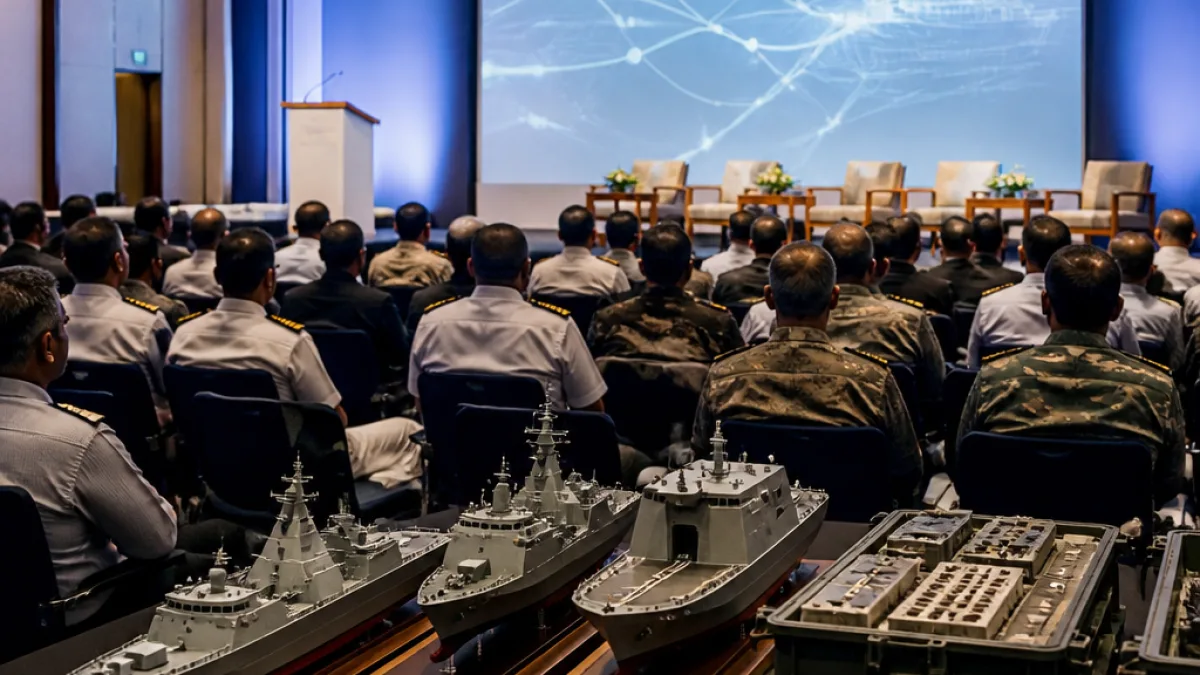
Defence Minister Rajnath Singh on 26 October called for a renewed, more ambitious push on defence self‑reliance — what he termed “Aatmanirbharta 2.0” — with an emphasis on resilient supply chains, concentrated research and development, and development of technologies usable by both civilian and military sectors. He made the remarks while addressing the Indian Navy’s Naval Innovation and Indigenisation Seminar, SWAVLAMBAN 2026, in New Delhi.
A strategic shift from procurement to supply‑chain security
Singh described supply‑chain management as “a strategic imperative” rather than a mere technical concern, warning that dependencies arise from limited domestic access to certain raw materials and missing technologies. He said some external dependencies may persist until domestic alternatives or viable substitutes are available, and urged prioritisation of critical areas for indigenisation.
“Supply chain dependencies arise from a limited domestic availability of certain raw materials, such as rare earth elements, and the absence of specific technologies within the country.” — Defence Minister Rajnath Singh
The minister added that the country should not wait for a crisis to identify vulnerabilities. He called for advance evaluation of buffer stocks, domestic production capacities and likely disruptions to supply routes. He also named research and development as central to overcoming these challenges and urged a change in the attitude towards failure in research activities.
Practical signals and procurement
At the seminar, Singh highlighted recent tangible outcomes from indigenisation efforts, noting naval contracts worth over ₹1,900 crore as demonstrations of progress. He urged the next phase of Aatmanirbharta to produce indigenous products that are cost‑effective, operationally superior and globally competitive — aligning the push with the government’s Viksit Bharat@2047 vision.
- Supply chains: treat management as a strategic function and identify critical import dependencies that need immediate attention.
- R&D: increase sustained investment, accept controlled failure in innovation, and prioritise dual‑use technologies.
- Inter‑service utilisation: develop technologies with applicability across the Army, Navy and Air Force.
The minister also stressed the need to prioritise technologies that have both civil and military applications and to ensure inter‑service utility. He said lack of funding should not become an obstacle and urged focus on areas that deliver the greatest strategic leverage.
What the seminar underlined
Swavlamban is positioned as the Navy’s main platform for engagement with industry, startups and academia on innovation and indigenisation. Singh’s speech reinforces the Ministry of Defence’s stated policy direction of moving beyond platform procurement to building resilient domestic ecosystems for defence production — including raw materials, supply chains and advanced technologies.
While the minister named supply‑chain vulnerabilities and the need for targeted R&D, he also pointed to procurement actions already under way, citing the naval contracts totalling more than ₹1,900 crore as evidence of “tangible results.” The minister’s call for Aatmanirbharta 2.0 places supply‑chain management, technology convergence and inter‑service application at the centre of India’s next phase of defence indigenisation.