
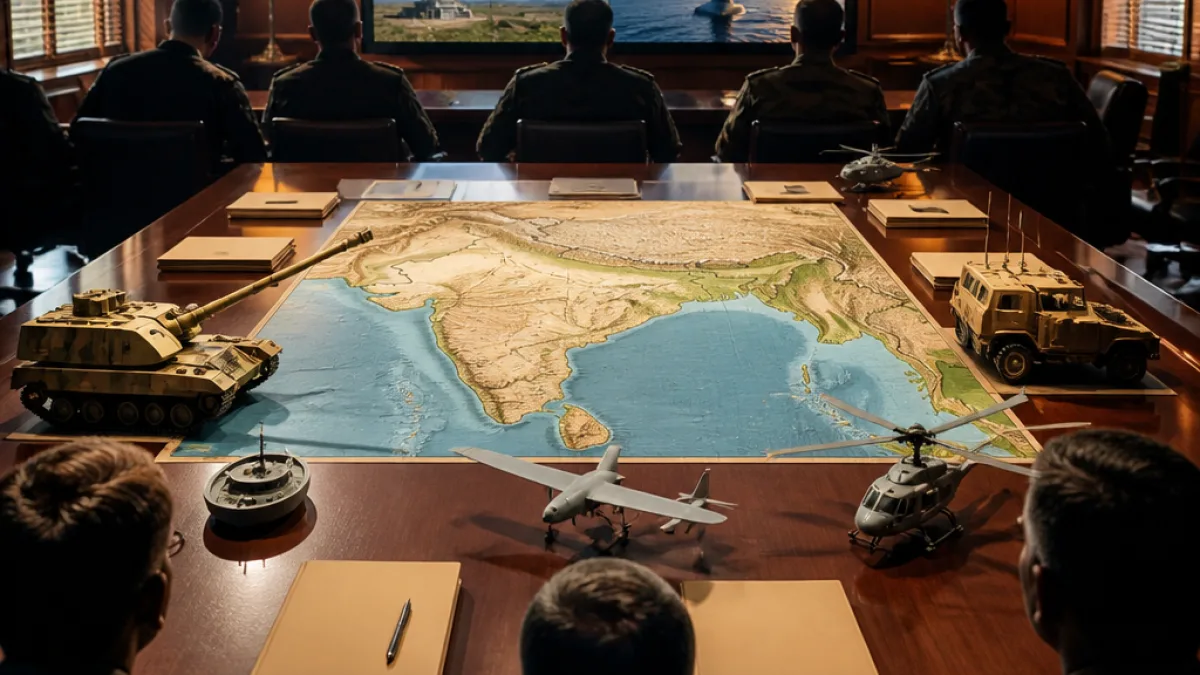
The Defence Acquisition Council (DAC), chaired by Defence Minister Rajnath Singh, on 26 October accorded Acceptance of Necessity (AoN) — in‑principle administrative approval — to a suite of capital acquisition proposals for the three services at an estimated value of about ₹2,12,000 crore, the Ministry of Defence said.
Major approvals for the Army, Navy and Air Force
According to the Ministry of Defence, the AoNs cover a range of systems intended to strengthen mobility, firepower, surveillance and counter‑air threats across environments.
- Indian Army: approvals include High Mobility Vehicles (HMV); a Self‑Propelled Tracked Gun System; a Gun Shot Response System (GSRS); Light Multi Role Helicopters (LMRH); Very Short‑Range Air Defence System (VSHORADS); a Platform Based Counter Unmanned Aerial System (C‑UAS); an Unmanned Aerial System Brick Long Range; Surveillance UAVs; an Integrated Surveillance and Strike System; and a Long Range Kamikaze Drone System.
- Indian Navy: the DAC approved procurement of an Active Offboard Decoy System (AODS) and “other major Naval platforms” described by the ministry as indigenously designed and constructed, to improve anti‑missile defence and overall combat capability.
- Indian Air Force: approvals include helicopters, air defence systems, weapons and a Mobile X‑Band Doppler Weather Radar System to enhance localised weather surveillance in forward areas, the ministry said.
What the ministry said about capability effects
The ministry said the HMVs will augment operational mobility and logistics in difficult terrain, while the Self‑Propelled Tracked Gun System will offer matched mobility and firepower for mechanised formations. The GSRS is described as a force multiplier to provide near‑real‑time situational awareness. The LMRH is expected to be employed by both the Army and the IAF for roles such as reconnaissance, surveillance, combat and search‑and‑rescue, together with humanitarian assistance and disaster relief tasks.
For naval forces, the AODS is intended to bolster defences against contemporary anti‑ship missile threats. The ministry characterised the approved major naval platforms as indigenously designed and constructed, with modern warfare capabilities that will enhance the Navy's combat power.
Procurement stage and what AoN signifies
The ministry emphasised that AoN represents in‑principle administrative clearance: it enables the projects to move into subsequent acquisition steps but is not a contract award or delivery order. Further decisions on procurement route, industry partners, timelines and contract values will follow as each proposal advances through the acquisition process.
| Service | Key items approved |
|---|---|
| Indian Army | HMV; Self‑Propelled Tracked Gun System; GSRS; LMRH; VSHORADS; Platform‑based C‑UAS; Unmanned Aerial System Brick LRR; Surveillance UAV; Integrated Surveillance & Strike System; Long Range Kamikaze Drone |
| Indian Navy | Active Offboard Decoy System (AODS); major indigenously designed and constructed naval platforms |
| Indian Air Force | Helicopters; air defence systems; weapons; Mobile X‑Band Doppler Weather Radar System |
The ministry's announcement did not include contract award dates, specific vendors or delivery schedules for the approved items. Each approved proposal will proceed through the standard acquisition workflow, including technical evaluations, trials where required, and final contract approvals.
Members of the defence and industrial communities will now await the next formal acquisition steps, which will detail procurement routes, indigenisation content and timelines as project‑specific approvals and contracts are issued.