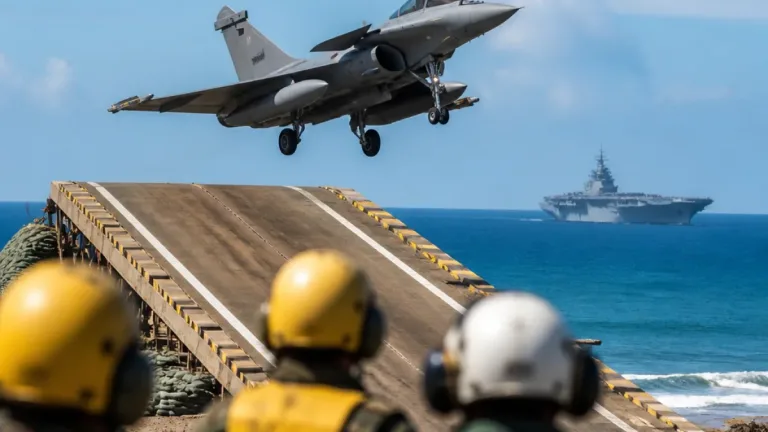
INS Vikrant, India’s first domestically built aircraft carrier, has received changes to its flight deck as the Indian Navy prepares to operate the Rafale M from the ship. The modifications were completed before the fighter made its first landing on the carrier, marking a key step in preparations for the planned induction of 26 naval variants from 2028 onwards.
The Rafale M touched down on INS Vikrant on 29 October 2026, making the landing at the first attempt. The event followed a week of trials at the shore-based test facility at INS Hansa in Goa. The carrier, which displaces 45,000 tonnes, is described as the largest warship built in India.
A new visual reference on the flight deck
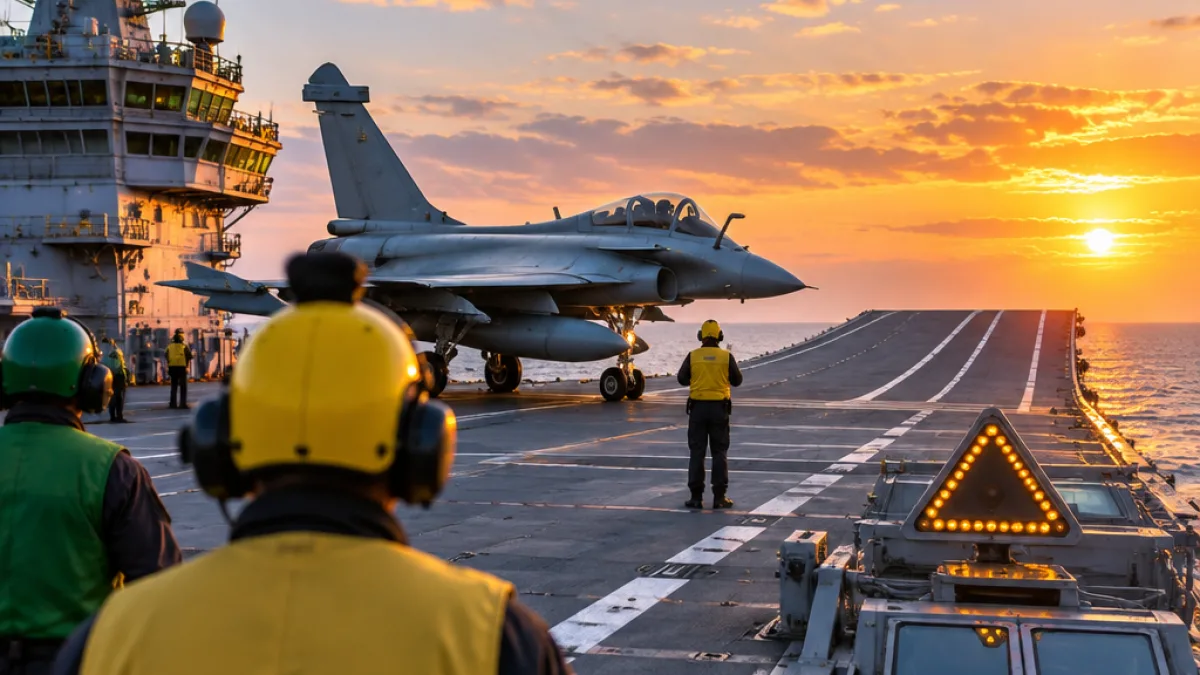
Among the changes made to the carrier is a triangular landing aid on the flight deck. The marking is similar to one used on the French aircraft carrier Charles de Gaulle. It provides an additional visual reference to help pilots judge their approach to the landing area, but does not replace the carrier’s optical landing system.
Carrier landings require the pilot to bring the aircraft on to a relatively short deck while the ship moves with the sea. The Rafale M approaches at about 240 kmph, with its tailhook intended to catch one of the carrier’s four arresting wires. Once the aircraft touches down, the wires bring it to a stop in approximately one to two seconds.
- The Rafale M’s first landing on INS Vikrant took place on 29 October 2026.
- The carrier has been fitted with a triangle landing aid as a supplementary approach reference.
- The Indian Navy plans to induct 26 Rafale M aircraft from 2028 onwards.
Why the approach system matters
Carrier pilots apply full power as the aircraft’s wheels meet the deck. This allows the fighter to take off again if the tailhook fails to engage an arresting wire, an event known as a bolter. The aircraft can then go around for another landing attempt.
Operations may take place at night or in poor weather. In those conditions, pilots use the optical landing system and receive guidance from the landing signals officer, who helps maintain the correct flight path. The optical system displays lights that indicate whether the aircraft is approaching on the prescribed glide slope. An approach that is too high or too shallow produces an incorrect light pattern.
| Feature | Detail |
|---|---|
| Carrier | INS Vikrant |
| Carrier displacement | 45,000 tonnes |
| Naval fighter | Rafale M |
| Planned aircraft quantity | 26 |
| Planned induction | From 2028 onwards |
The triangle marking therefore works alongside, rather than in place of, the existing optical landing equipment. Its addition ahead of the Rafale M’s carrier trial reflects the practical changes required to prepare INS Vikrant for the new aircraft.
The successful landing was the first carrier landing by the Rafale M on INS Vikrant. The planned induction of the 26 aircraft from 2028 will add the French naval fighter to the Indian Navy’s carrier aviation programme, with the ship’s flight-deck arrangements and landing systems now being prepared for that aircraft.