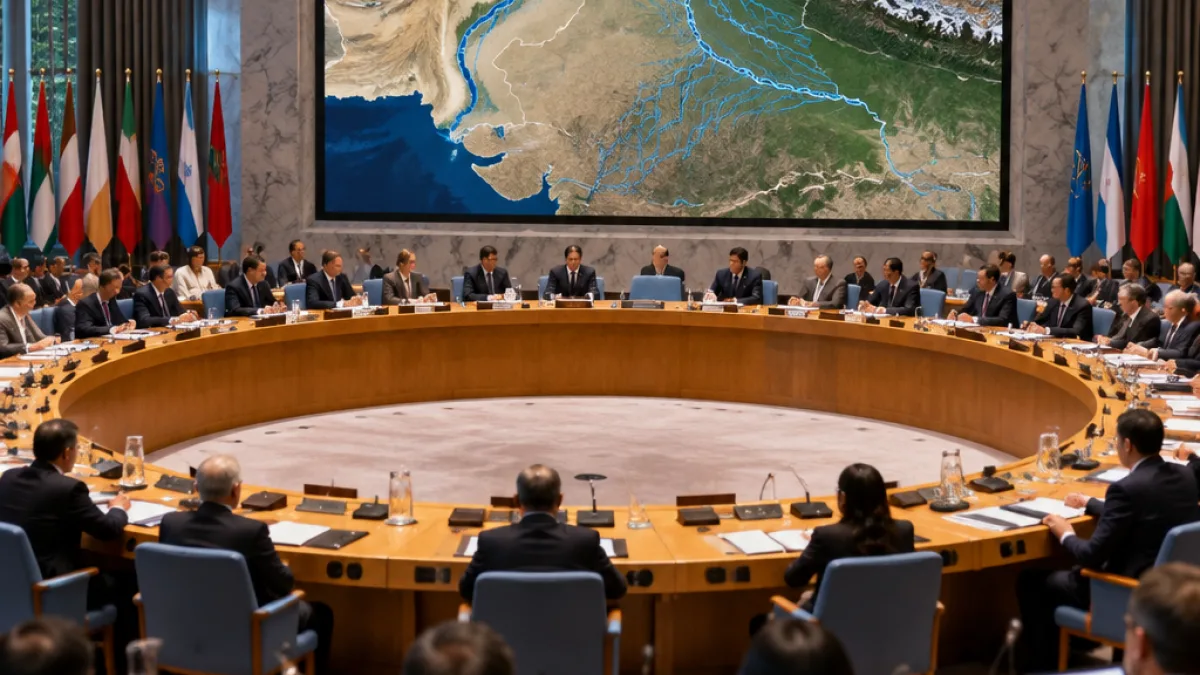
India defended its position on the Indus Waters Treaty (IWT) at a UN Security Council meeting after Pakistan raised the issue during a discussion on natural resources and conflict prevention. India’s Permanent Representative to the United Nations, Ambassador Harish Parvathaneni, said New Delhi had not intended to bring bilateral disputes with Pakistan into the forum.
Parvathaneni said the Indian delegation was responding because Pakistan had used the discussion to make what he described as unfounded allegations. He referred to existing international mechanisms for handling disputes involving natural resources and cited the Kimberley Process as an example of international cooperation that had helped curb the trade in conflict diamonds while allowing legitimate commerce to continue.
“Chair, it was not our intention to bring other issues into this forum. But my delegation is compelled to respond to the comments made by the delegation of Pakistan that has chosen to misuse today’s discussion to paddle its propaganda.”
New Delhi reiterates its treaty position
India’s representative said the country’s position on the Indus Waters Treaty remained “consistent and clear” and had already been set out at several forums. The treaty is currently in abeyance, according to the statement, which did not indicate any change in New Delhi’s position during the UN discussion.
Pakistan had used its intervention to criticise India’s decision concerning the treaty and to raise concerns about shared water resources. India rejected the characterisation of its position and said the Pakistani delegation’s conduct had made a response necessary to correct what it considered to be misleading claims.
- India’s position: New Delhi said its stand on the IWT had been consistently articulated and defended the use of established international mechanisms.
- Pakistan’s position: Islamabad raised the treaty and alleged that India was using the issue to exert political pressure.
- UN setting: The exchange took place during an Arria-formula UN Security Council meeting on natural resources and conflict prevention.
Exchange comes amid continuing bilateral tensions
The remarks brought the India-Pakistan dispute over the river-water agreement into a wider UN discussion on the management of natural resources. Parvathaneni said India did not want the bilateral issues between the two countries to dominate the meeting, but maintained that Pakistan’s intervention required a formal clarification.
He also referred to Pakistan’s use of what he described as terror proxies in its neighbourhood and criticised the influence of the Pakistan Army over public life in that country. Those comments formed part of India’s broader response to the Pakistani delegation rather than a separate announcement on the treaty.
The exchange reflects the continuing diplomatic dispute between New Delhi and Islamabad over the status and implementation of the Indus Waters Treaty. At the meeting, India presented its position as one based on existing international mechanisms, while Pakistan continued to challenge New Delhi’s decision and urged respect for the 1960 agreement.