India has urged the United Nations Human Rights Council (UNHRC) to maintain sustained attention to terrorism, describing the threat as one of the gravest challenges to human rights and particularly to the right to life.
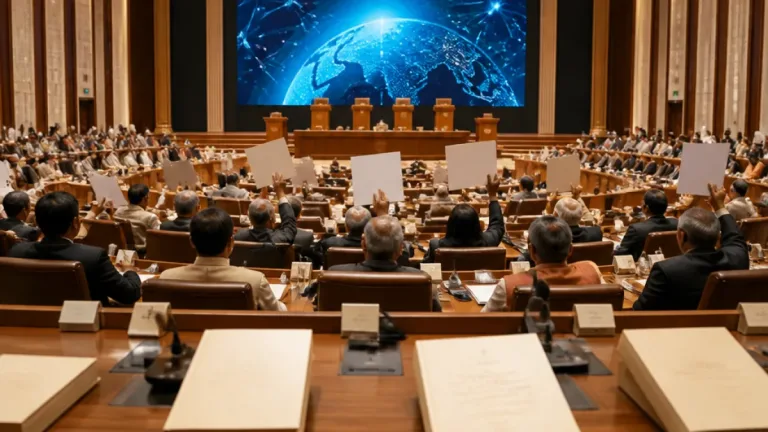
First Secretary at India’s Permanent Mission to the United Nations, Bhavika Mangalanandan, made the remarks while addressing the United Nations General Assembly in New York, according to Akashvani News. India’s intervention linked the protection of human rights with stronger international action against terrorism.
Call for stronger international coordination
Mangalanandan referred to a UNHRC resolution on international cooperation adopted in Geneva in July 2026. The resolution called on the international community to take necessary steps to strengthen cooperation in preventing and combating terrorism.
India urged the Council to address terrorism consistently and said its approach should be guided by the principle of zero tolerance towards terrorism. The position places emphasis on sustained cooperation between countries rather than treating counter-terrorism as an issue limited to individual national jurisdictions.
- India described terrorism as a serious threat to the enjoyment of human rights.
- New Delhi referred to the UNHRC resolution adopted in Geneva in July 2026.
- India called for stronger cooperation to prevent and combat terrorism.
Warning against politicisation
India also criticised what it described as the politicisation and “weaponisation” of human-rights issues, along with the application of double standards. Mangalanandan cautioned that such practices undermine the credibility of the Human Rights Council.
The remarks come as India continues to press international institutions to treat terrorism as a central security and human-rights concern. The intervention did not identify a particular attack, organisation or country, but focused on the need for consistent institutional attention and cooperation.
For India, the UNHRC platform provides an avenue to argue that the right to life must be protected from terrorist violence while counter-terrorism measures remain part of broader international efforts to uphold human rights. The statement also reflects New Delhi’s objection to selective treatment of terrorism and human-rights concerns in multilateral forums.
India’s position, as presented at the United Nations on 31 October 2026, was that the Council’s credibility depends on applying its principles consistently and maintaining focus on terrorism as an ongoing threat rather than addressing it only when particular crises attract international attention.