Denmark’s parliament approved a security agreement with the United States on Thursday, 19 November 2026, clearing the final legislative hurdle for an expansion of American military access to Greenland. The agreement allows the US to modernise existing defence facilities and develop additional military infrastructure on the strategically located Arctic island.
The decision follows months of diplomatic tension after US President Donald Trump repeatedly said he wanted the United States to take control of Greenland. Denmark has maintained that the island’s sovereignty is not negotiable. The agreement provides for a wider US military role without altering Greenland’s political status, according to the details reported about the parliamentary approval.
What the agreement allows
The arrangement expands the military access available to Washington under the framework of the 1951 US-Denmark defence pact. It also establishes a basis for stronger American missile-defence capabilities in the Arctic, including support for Trump’s proposed Golden Dome system.
| Area | Provision reported |
|---|---|
| Military access | Expanded US access to Greenland |
| Infrastructure | Modernisation of existing facilities and construction of additional military infrastructure |
| Missile defence | Support for stronger American capabilities in the Arctic, including the proposed Golden Dome system |
| Political status | Greenland’s sovereignty remains unchanged |
Reuters reported that the agreement was negotiated after the tensions generated by Trump’s ambition to bring Greenland under US control. Denmark’s position has been that the island must remain under its sovereignty, while Washington has sought a larger strategic and military role there. The accord is intended to accommodate expanded defence cooperation while retaining the existing political arrangement.
Why Greenland matters to Washington
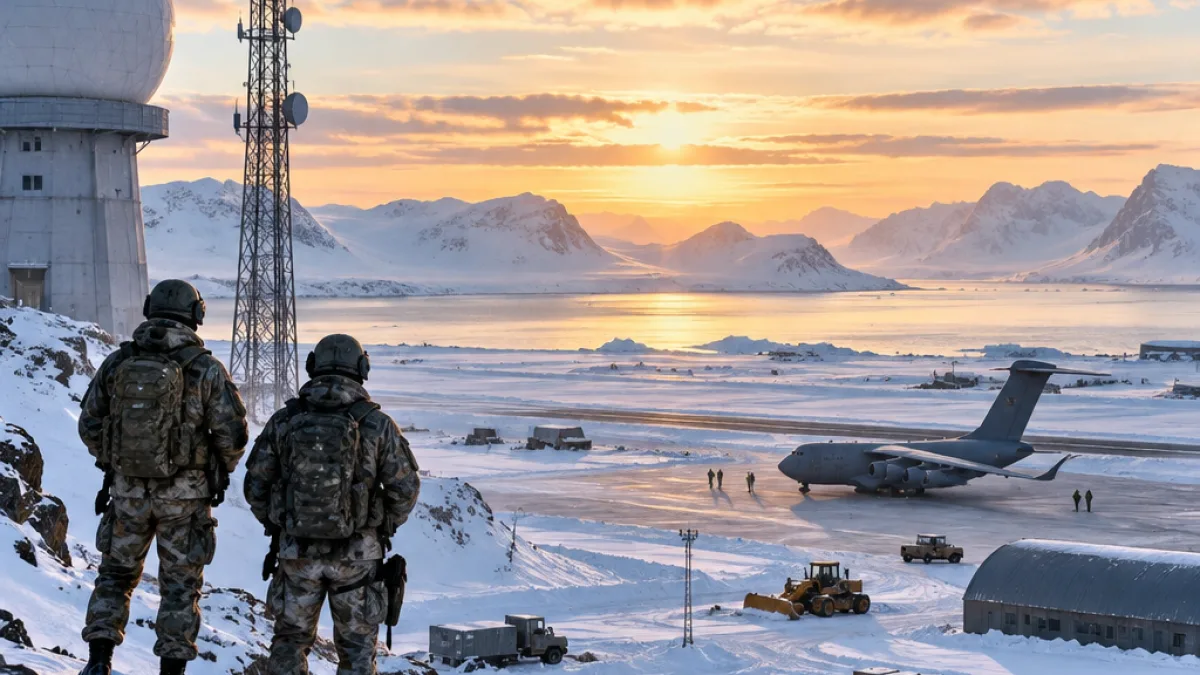
Greenland occupies a position between North America, Europe and the Arctic, giving it importance for missile warning, space surveillance and monitoring military activity in the northern approaches. The island hosts the US-operated Pituffik Space Base, which supports missile warning, missile defence and space surveillance missions.
Greenland also lies near the Greenland-Iceland-UK gap, commonly known as the GIUK gap. The maritime corridor is important for monitoring Russian submarines and naval movements between the Arctic and the North Atlantic. The agreement therefore places additional emphasis on the military value of the island at a time when the United States is increasingly focused on activity by Russia and China in the Arctic.
- The agreement expands US military access without transferring Greenland’s sovereignty.
- Existing defence facilities may be modernised and further military infrastructure may be established.
- The arrangement includes a framework for Arctic missile-defence cooperation.
- Greenland’s Pituffik Space Base and its position near the GIUK gap remain central to its strategic importance.
The agreement also seeks to restrict the military and strategic presence of countries outside NATO in Greenland. Its security provisions are consequently linked not only to US-Danish defence relations, but also to wider concerns over Russian and Chinese ambitions in the Arctic. For NATO, the arrangement strengthens the alliance’s ability to use a strategically placed territory for surveillance, missile warning and maritime security while avoiding a change in Greenland’s political status.