
Indira Gandhi’s record in war and strategic affairs is being recalled in India on her 109th birth anniversary, with Prime Minister Narendra Modi paying tribute to the former Prime Minister on 19 November 2026. Her years in office included the 1971 India-Pakistan war, India’s first nuclear test and major decisions that shaped the country’s security and economic policy.
A decisive chapter in the 1971 war
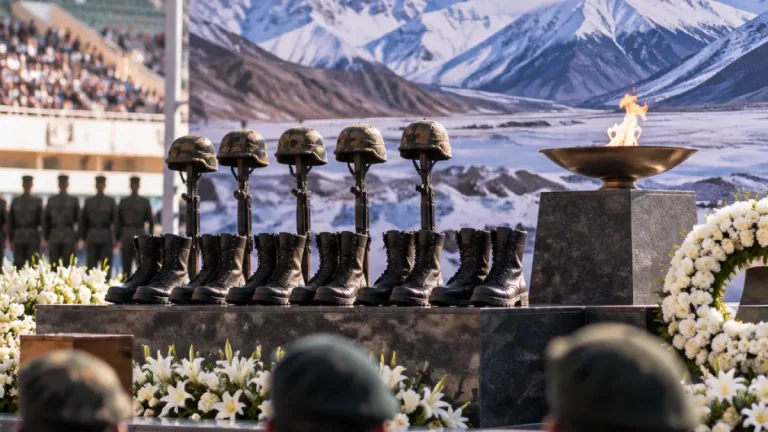
Gandhi was Prime Minister when the India-Pakistan war of 1971 transformed the political map of South Asia. The conflict ended on 16 December 1971 with the surrender of Pakistani forces in Dhaka, after which Bangladesh emerged as an independent country. The outcome strengthened Gandhi’s position as a national leader and remains one of the defining military and diplomatic episodes of post-Independence Indian history.
The war formed part of a wider period in which India’s military capabilities, diplomatic choices and regional security concerns were closely connected. The account of Gandhi’s tenure describes the 1971 result as a defining moment in her leadership, while also placing it alongside decisions that affected the country’s political and economic direction.
Pokhran and India’s nuclear capability
India carried out its first nuclear test at Pokhran on 18 May 1974, during Gandhi’s tenure. The test was officially described as a peaceful nuclear experiment and became an important milestone in India’s scientific and strategic history. It demonstrated the country’s nuclear capability and added a strategic dimension to the national-security record of the period.
The Pokhran test was not presented as an isolated scientific event. It was part of a period in which India was developing capabilities and institutions with long-term implications for national security. The test’s place in India’s strategic history continues to be discussed alongside the 1971 war, which showed the importance of military preparedness and state decision-making during a major regional crisis.
Political decisions with national consequences
Indira Gandhi served as Prime Minister from January 1966 to March 1977 and again from January 1980 until her assassination in October 1984. Her tenure also included the nationalisation of 14 major commercial banks on 19 July 1969, followed by six more in 1980. The banking policy sought to direct credit towards development priorities and expand access in previously underserved sectors.
Her legacy remains contested, particularly because of the Emergency from June 1975 to March 1977. During that period, civil liberties were curtailed, newspapers were censored and opposition leaders were jailed. Reports of forced sterilisation campaigns and abuses of state power made the Emergency one of independent India’s most serious democratic crises.
On 19 November, Modi paid tribute to Gandhi on X. Karnataka Chief Minister D K Shivakumar also recalled her influence on India’s political and economic development, including agriculture, banking access and support for the country’s space and nuclear programmes. For India’s military and strategic history, the 1971 war and the 1974 Pokhran test remain the principal national-security milestones associated with her years as Prime Minister.
- 1971: The India-Pakistan war ended with the surrender of Pakistani forces in Dhaka and the emergence of Bangladesh.
- 18 May 1974: India conducted its first nuclear test at Pokhran.
- 1966–1977 and 1980–1984: Gandhi served as Prime Minister during two periods of office.