The US Army is widening access to two Indiana National Guard facilities for companies developing and evaluating drone and counter-drone systems. The decision, announced on 28 October 2026, brings Camp Atterbury Joint Maneuver Training Center and Muscatatuck Training Center into the Army’s Permissive Test Range Expansion Initiative.
The arrangement will be implemented through cooperation between the Army Test and Evaluation Command (ATEC) and the Indiana National Guard. Commercial developers will be able to use the sites for research, development and system hardening in military-style settings, reducing administrative obstacles that can delay access to government testing infrastructure.
| Facility | Testing environment |
|---|---|
| Camp Atterbury Joint Maneuver Training Center | More than 34,000 acres of secure test space and restricted airspace extending to 40,000 feet |
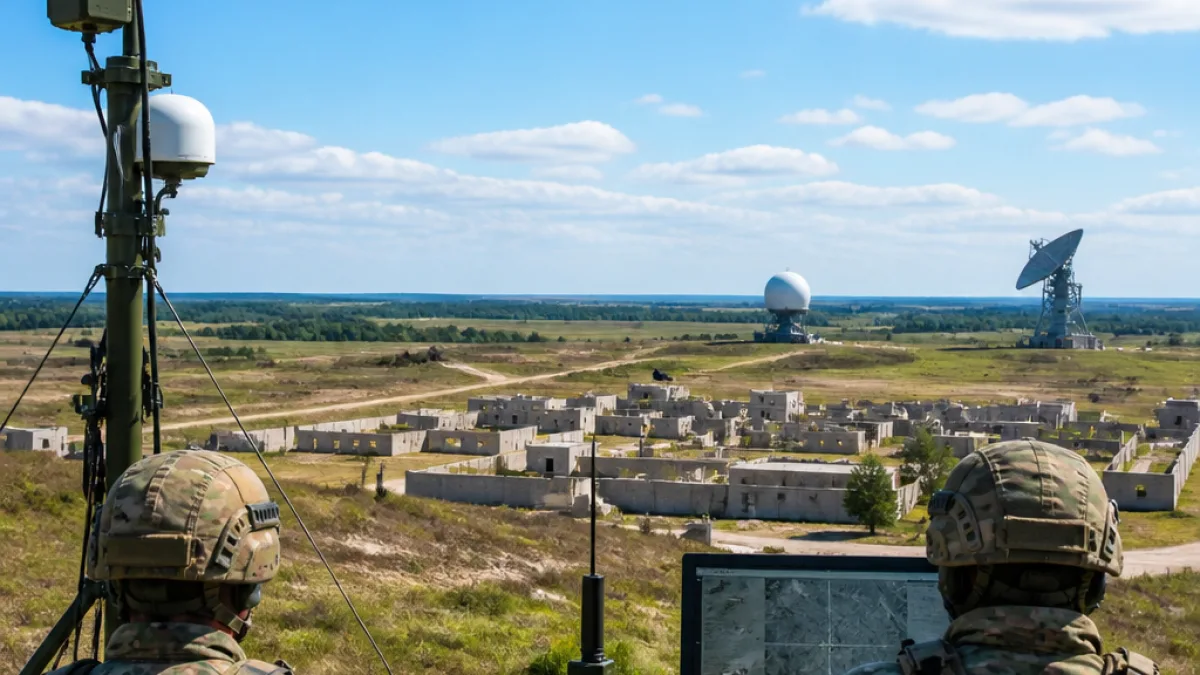
| Muscatatuck Training Center | A 1,000-acre developmental site with configurable urban infrastructure |
Camp Atterbury offers a large secured area and a dedicated restricted airspace corridor. Muscatatuck, by contrast, is configured around built-up surroundings that can support testing involving navigation and tracking in complex urban conditions. The Army said the two locations will allow developers to examine emerging systems under conditions closer to those encountered in military operations than may be possible on private property.
“Camp Atterbury and Muscatatuck give commercial developers the ranges and airspace they need to test what actually works. The Army’s job is to get those systems into formations quickly. These ranges cut the time between a commercial system and a Soldier who can use it.”
— Gen. Christopher LaNeve, vice chief of staff and acting chief of staff of the Army
The expansion was announced by Acting Secretary of the Army Adam Telle at the 5th Annual Northeast Indiana Defense Summit. It represents an effort to move testing beyond laboratory or commercial conditions and towards environments where airspace restrictions, terrain and built infrastructure can be controlled for military evaluation.
What the Indiana facilities will offer
According to Maj. Gen. Pat Gaydon, commanding general of ATEC, the initiative is intended to provide developers with both the physical space and restricted airspace needed to mature their systems. The Army described the access as part of a broader attempt to make military ranges more usable by private-sector innovators.
- Camp Atterbury: a large secure area with a restricted airspace corridor reaching up to 40,000 feet.
- Muscatatuck: an urban-style developmental environment for drone navigation and tracking trials.
- Intended users: commercial developers seeking military-relevant conditions for research, development and hardening.
The announcement concerns testing access, not the procurement or induction of a particular drone or counter-drone system. No contract, delivery schedule or operational deployment was announced alongside the expansion. The stated objective is to reduce the time required to take a commercial technology through testing and towards possible use by soldiers.