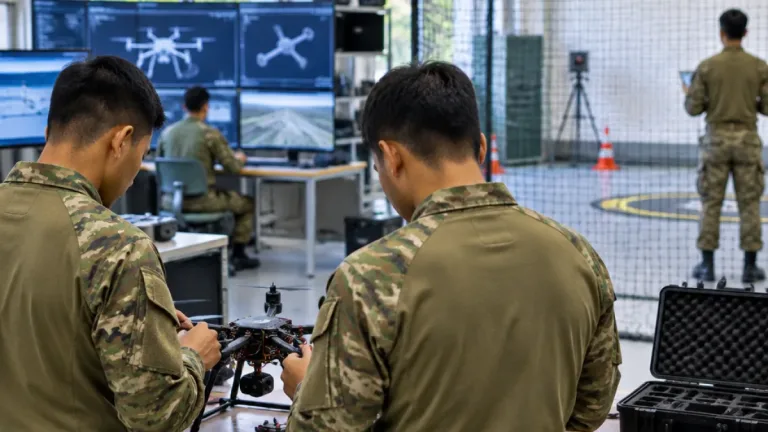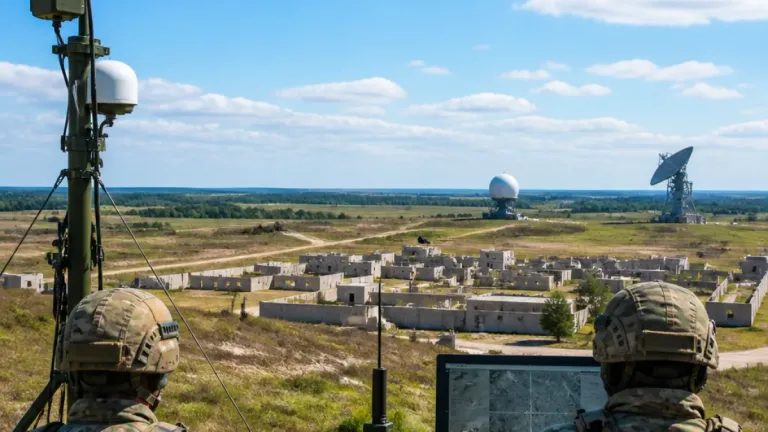
South Korea’s Ministry of National Defense has launched a new headquarters for drone and counter-drone capabilities, placing the development of unmanned warfare systems under a dedicated organisation as North Korea expands its own drone programme.
The inauguration ceremony was held on Monday, 2 November 2026, at the Defense Drone Headquarters in Pocheon, about 40 kilometres north of Seoul. Vice Defense Minister Lee Doo-hee and other military officials attended the event, the ministry said.
A central body for drone and counter-drone policy
The new headquarters replaces the existing Drone Operations Command. While the earlier command was primarily focused on carrying out drone missions, the new organisation will act as a service-wide control tower for unmanned systems and defences against them.
Its responsibilities include framing South Korea’s drone and counter-drone strategies, guiding the development of related systems across the armed services and supporting faster acquisition. The individual military branches will handle the combat employment and strike roles of drones and counter-drone systems, while the Joint Chiefs of Staff will coordinate overall operations.
- The headquarters will formulate drone and counter-drone strategies.
- The armed services will retain responsibility for combat and strike employment.
- The Joint Chiefs of Staff will coordinate operations across the services.
- The organisation will support quicker procurement of unmanned and counter-UAS systems.
“We take North Korea's advancing drone capabilities and related threats very seriously, although evaluating drone power requires looking beyond mere performance to fully consider detection, identification, tracking and countermeasure systems,” the Ministry of National Defense said.
North Korean drone activity drives the change
South Korea’s decision follows a comprehensive unmanned systems development policy announced in June. The policy was designed to strengthen the country’s defence capabilities as drones become an increasingly important element of modern warfare.
The ministry said North Korea is accelerating its drone development after drawing lessons from the deployment of its troops in Russia’s war against Ukraine. Pyongyang also conducted weapons tests last week that simulated mass drone attacks against mock South Korean military guard posts and United States tanks, according to the account carried by the South Korean defence authorities.
North Korean leader Kim Jong-un was also shown visiting the Unmanned Aerial Technology Development 2026 exhibition on the 29th, accompanied by his daughter Ju-ae, wife Ri Sol-ju and military officials. During the visit, he passed a large reconnaissance drone resembling the Global Hawk, bearing the words “Unmanned Aerial Technology Federation” on its fuselage.
Faster procurement and domestic production
Seoul is introducing an expedited certification system for commercial drones and associated equipment. The arrangement is intended to allow the military to purchase ready-made systems more quickly than under conventional procurement procedures.
South Korea also plans to localise the production of drones and components including batteries and engines, with the stated aim of reducing dependence on China. The Ministry of National Defense said it intends to procure more than 20,000 low-cost one-way combat drones and accelerate the Korean Low-Cost Uncrewed Combat Attack System programme, which includes domestically developed long-range loitering munitions.
The restructuring separates the headquarters’ role as a developer and coordinator from the services’ operational responsibilities. For South Korea, the move links battlefield employment, counter-drone protection, acquisition and industrial capability within a single unmanned-systems framework, against the backdrop of North Korea’s reported mass-attack exercises and continuing drone development.