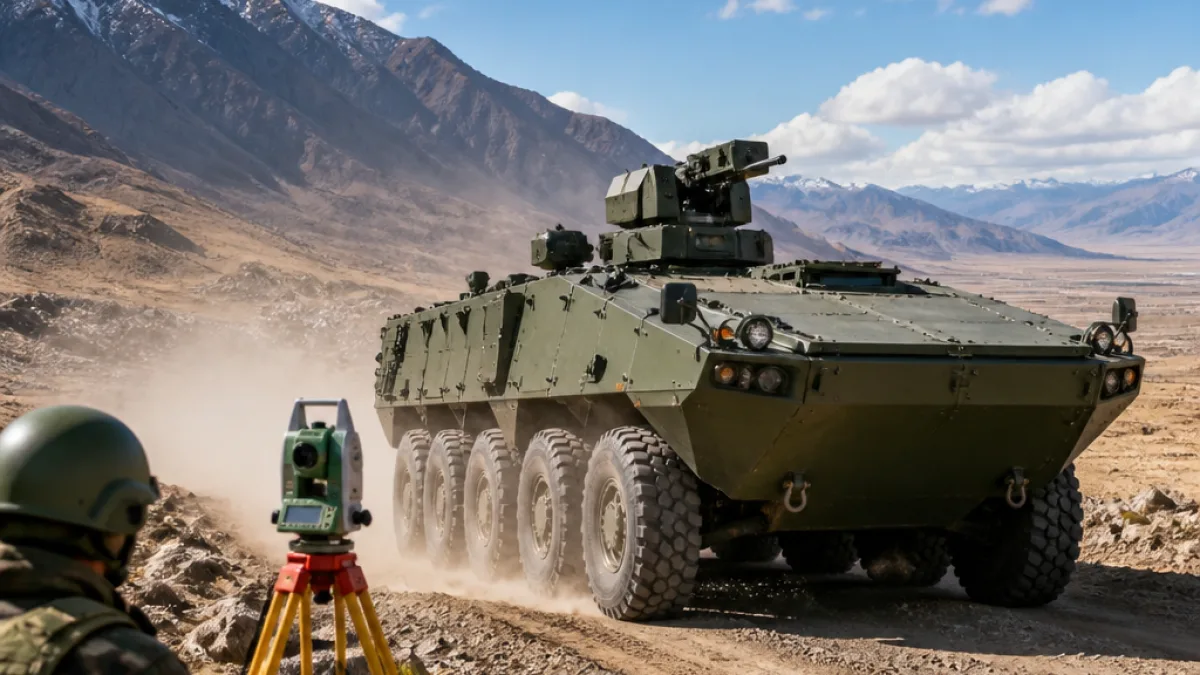
The Defence Research and Development Organisation (DRDO) has moved the wheeled version of its next-generation infantry combat vehicle closer to Indian Army evaluation after the platform met operational requirements during development trials, officials said. The programme is intended to produce a successor to the Army’s Russian-origin BMP-II fleet, which has formed the mainstay of Indian mechanised infantry since the 1980s.
The vehicle has been developed by the Vehicle Research and Development Establishment (VRDE), a DRDO laboratory in Ahilyanagar, together with two private companies and several micro, small and medium enterprises. Both tracked and wheeled configurations are being pursued. Prototypes of the platforms were unveiled on 25 April 2026, and trials of the two variants are continuing in parallel.
“We have carried out extensive trials of the wheeled platform while testing of the tracked variant is also progressing in parallel. Trials of the wheeled vehicle have been encouraging as it met operational requirements such as mobility, trench crossing and, most importantly, amphibious capability with the turret,” a senior DRDO official said.
Army assessments will cover varied terrain
The next phase will place the wheeled vehicle under Army-led evaluation in deserts, plains and high-altitude regions. The testing will examine mobility, the performance of its weapons systems, firing capability and functioning under different operating conditions. Feedback from these assessments is expected to guide design changes before the platform can proceed towards induction.
- Wheeled variant: has completed development trials cited by DRDO officials, including assessments of mobility, trench crossing and amphibious capability with the turret.
- Tracked variant: remains under testing alongside the wheeled platform.
- Potential induction: targeted for 2029, subject to successful trials and acceptance by the Indian Army.
The programme’s immediate significance lies in the transition from developer-led trials to service evaluation. Meeting stated operational requirements during development testing does not by itself amount to Army acceptance or an induction order. The Army’s observations in different terrain and climate conditions will determine whether modifications are required before the vehicle advances further.
| Programme element | Position reported |
|---|---|
| Developer | DRDO’s Vehicle Research and Development Establishment |
| Configurations | Tracked and wheeled variants |
| Industrial participation | Two private companies and several micro, small and medium enterprises |
| Induction target | 2029, subject to testing and Army acceptance |
Replacement for a long-serving fleet
The Vikram VT-21 is being developed against the requirement to replace the Army’s ageing BMP-II infantry combat vehicles. The BMP-II fleet has served with mechanised infantry for decades, making the outcome of the new vehicle’s trials relevant to the Army’s future protected mobility and infantry support requirements.
DRDO officials also placed the programme in the wider evolution of infantry combat vehicles. Platforms cited in this context include the US Army’s Bradley Fighting Vehicle, Germany’s Puma, Sweden’s CV90 family, South Korea’s K21 and Russia’s Kurganets-25. The comparison reflects the broad shift towards vehicles combining mobility, protected crew compartments, integrated weapon systems and battlefield connectivity, although the Indian platform’s progression will depend on its own Army trials and acceptance process.