India has demonstrated directed‑energy systems capable of destroying small unmanned aircraft at a very low per‑engagement cost, a former DRDO technology chief told a news programme, signalling progress in an area defence planners worldwide are prioritising.
Prof Hari Babu Srivastava, who served as Director General, Technology Management, DRDO, and as Director of the Laser Science and Technology Centre (LASTEC), said India has already shown the technology required to reach extremely low operating costs for laser engagements. He told WION's Defence Pulse that the primary consumable cost of a laser shot is the electricity used to generate the beam and that India’s systems can operate at the scale of a few hundred rupees per engagement.
“We have already done it,” Prof Hari Babu Srivastava said.
What has been demonstrated
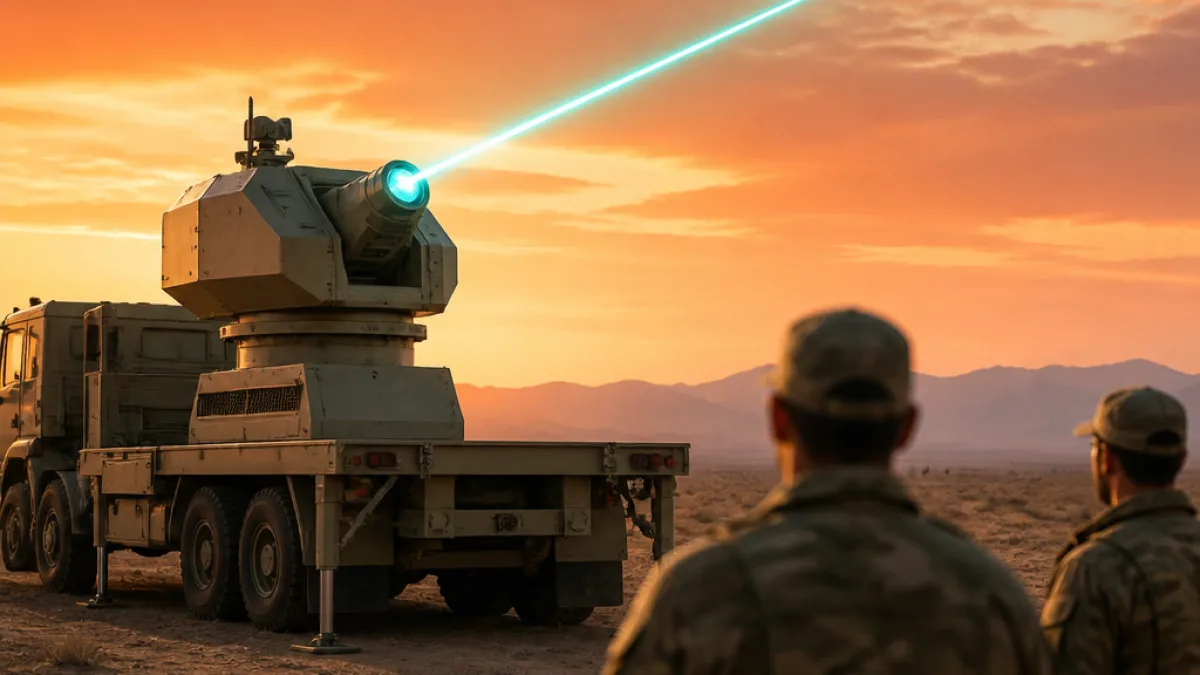
DRDO’s publicly disclosed demonstration in April 2025 is central to the claim. The organisation successfully trialled a 30‑kilowatt Mk‑II(A) laser‑directed energy weapon at Kurnool, Andhra Pradesh; DRDO said the system engaged drones and disabled surveillance sensors. According to Srivastava, DRDO has moved from demonstration towards industrialisation by initiating the process to transfer the capability to Indian industry.
- Platform tested: 30 kW Mk‑II(A) laser (April 2025, Kurnool) — engaged drones and disabled surveillance sensors.
- Cost advantage: claimed per‑engagement cost of only a few hundred rupees, driven largely by electrical energy consumption.
- Industrialisation: DRDO has begun capability transfer to industry, Srivastava said.
How India’s programme compares internationally
Srivastava contrasted India’s trajectory with international efforts. He noted that directed‑energy programmes are accelerating elsewhere; the United States has been expanding its own laser counter‑drone work and in September 2026 the US Army awarded a contract of about $465 million to AeroVironment for LOCUST laser counter‑drone systems. He also outlined the limits and complementary nature of directed‑energy approaches: a laser typically engages one target at a time, while high‑power microwave (HPM) systems can affect multiple unmanned platforms within an area by disrupting electronics.
Srivastava observed that the two technologies would therefore serve complementary roles in counter‑UAS (C‑UAS) architectures: lasers for precise, low‑cost neutralisation of individual small aircraft and HPMs for broader electronic disruption of swarms.
Implications for procurement and deployment
The statements underline two practical issues policy makers and military planners consider when evaluating directed‑energy systems: operational costs per engagement and the path from laboratory demonstration to deployable, maintainable systems provided by industry. DRDO’s initiation of transfers to industry was highlighted by Srivastava as an important step in moving from tests towards fieldable capability.
| Aspect | Detail |
|---|---|
| Demonstrated system | 30‑kilowatt Mk‑II(A) laser (DRDO), April 2025, Kurnool |
| Claimed per‑engagement cost | “A few hundred rupees” (as stated by Prof Hari Babu Srivastava) |
| Industrial transition | DRDO has initiated capability transfer to Indian industry (as stated) |
The source emphasised that while lasers are cost‑efficient for single targets, countering coordinated swarms will demand layered solutions combining kinetic, electronic and directed‑energy tools. Srivastava mentioned that higher‑power lasers, especially when deployed at altitude, could extend the range of threats that directed energy might counter, but did not provide technical timelines or capability thresholds.
For Indian defence planners and homeland security agencies, the claim of low per‑shot cost matters: it changes the economics of repeated engagements against inexpensive commercial drones. The transfer of technology to industry will be the next critical phase for converting demonstrations into units that can be integrated on naval ships, airfields, bases and critical infrastructure protection systems.
All operational statements and technical claims in this article are attributed to Prof Hari Babu Srivastava and to DRDO’s publicly reported April 2025 trial as cited in the interview.