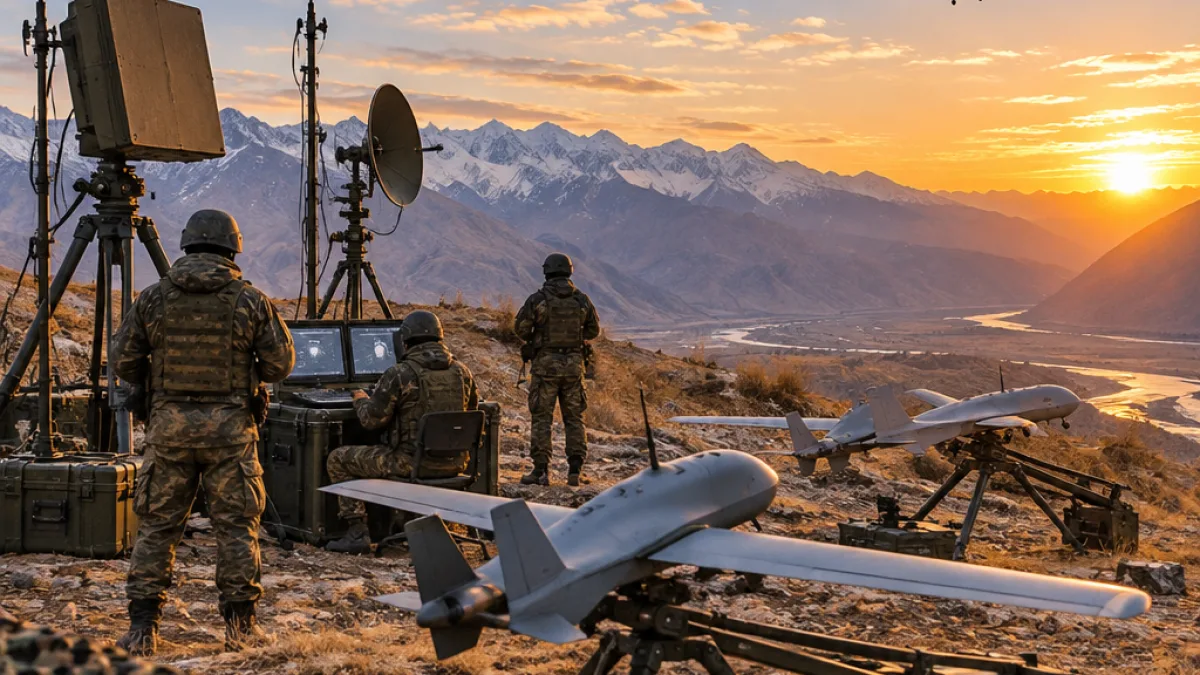
Pakistan’s military has claimed that it has a higher level of operational readiness for drone warfare than India and the Afghan Taliban, according to remarks by Inter-Services Public Relations Director General Lieutenant General Ahmed Sharif Chaudhry. The comments were made in an interview with Reuters, excerpts of which were reported by Dawn on 1 November 2026.
Chaudhry said Pakistan’s armed forces were adapting to changes in the nature of conflict. He referred to the requirements of both contact and remote combat, along with cyber operations, unmanned systems and long-range missions. His remarks did not disclose specific operational methods or deployments involving artificial intelligence, quantum technologies or cyber capabilities. He said, however, that such technologies could and should be used by the military.
Claims linked to the May 2025 conflict
In discussing the use of drones, Chaudhry referred to the India-Pakistan hostilities of May 2025. He claimed that Pakistan had shot down dozens of high-technology drones launched across its eastern border during that conflict. The claim was presented by Dawn as a statement by Pakistan’s military leadership and was not independently established in the report.
The remarks come as both countries continue to develop capabilities for detecting, disrupting and employing unmanned systems. Pakistan’s military spokesperson did not provide figures for its drone fleet, identify particular platforms or describe the systems it said had improved its readiness. The interview also did not set out a comparison based on independently verified performance data.
Pakistan’s concerns along the Afghan border
Chaudhry said Pakistan did not regard the Afghan Taliban’s use of drones as a separate, defining threat. He claimed that the Taliban did not possess military capabilities independent of outside support and described them as proxies of India. That characterisation is Pakistan’s position; the report did not provide supporting evidence for it, and India’s response was not included.
Pakistan has repeatedly demanded that the administration in Kabul act against bases and shelters that Islamabad says are used by armed groups, including the Tehreek-e-Taliban Pakistan, which is banned in Pakistan. Pakistani officials have blamed such groups for attacks inside the country, while the Taliban have rejected Islamabad’s allegation that Afghan territory is being used as a base for those attacks.
- Pakistan’s claim: its armed forces have greater drone-war readiness than India and the Afghan Taliban.
- Technology focus: the military spokesperson cited drones, cyber operations, artificial intelligence, quantum technologies and long-range missions.
- May 2025 reference: Pakistan claimed it destroyed dozens of high-technology drones, a statement attributed to its military leadership.
Talks have not resolved the dispute
The report said discussions involving Pakistan and the Taliban administration, mediated by Qatar, Turkey and China, had produced no result. Russia had offered to facilitate further engagement, according to the account. Chaudhry said Pakistan did not support isolating Afghanistan, but argued that the international community should press the authorities in Kabul to take actions expected of a state.
He also called for an end to support for what Pakistan describes as terrorism inside the country and opposed the sheltering of leaders of armed groups. The statements place Pakistan’s drone preparations within a wider security debate involving its eastern border with India, the western frontier with Afghanistan and the military’s stated intention to incorporate emerging technologies into future operations.