The Central Industrial Security Force (CISF) has implemented a major organisational restructuring, moving from a largely territorial command model to one based on the function and strategic importance of the assets it protects. The change has been approved by the Ministry of Home Affairs (MHA) and took effect on 2 November 2026.
Under the revised arrangement, similar installations will be brought under specialised commands rather than being grouped mainly according to their geographical location. The CISF said the objective is to improve coordination, preparedness and the protection of infrastructure whose disruption could have wider national and economic consequences.
“Effective today, the CISF has officially moved from a territorial command structure to a highly specialised, functional sector structure,” the CISF said.
Eight of 11 territorial sectors reorganised
Before the change, a single territorial sector headquarters could oversee more than 50 units spread across different categories of infrastructure. These included power plants and coal mines, often requiring coordination with several ministries and organisations. The force said the new model is intended to place related units under one command and create a more focused security structure.
Eight of the CISF’s 11 territorial sectors have been reorganised or renamed. The principal changes are:
- The Western Sector, headquartered in Mumbai, is now the West Coast Port Sector.
- The Southern Sector, headquartered in Chennai, has become the East Coast Port Sector.
- The Eastern Sector at Ranchi is now the Coal Sector.
- The Central Sector at Bhilai has been redesignated the Steel Sector.
- The North Eastern Sector at Guwahati is now the Petroleum and Natural Gas Sector.
- The North Sector at New Delhi has become the Power-I Sector, while the North Eastern Sector-II at Kolkata is now the Power-II Sector.
- The National Capital Region Sector has been reorganised in New Delhi as the Government Buildings, Museums and Monuments and Mass Rapid Transit System (GBMM & MRTS) Sector.
| Earlier sector | New designation | Headquarters mentioned |
|---|---|---|
| Western Sector | West Coast Port Sector | Mumbai |
| Southern Sector | East Coast Port Sector | Chennai |
| Eastern Sector | Coal Sector | Ranchi |
| Central Sector | Steel Sector | Bhilai |
| North Eastern Sector | Petroleum and Natural Gas Sector | Guwahati |
| North Sector | Power-I Sector | New Delhi |
Security based on the role of an asset
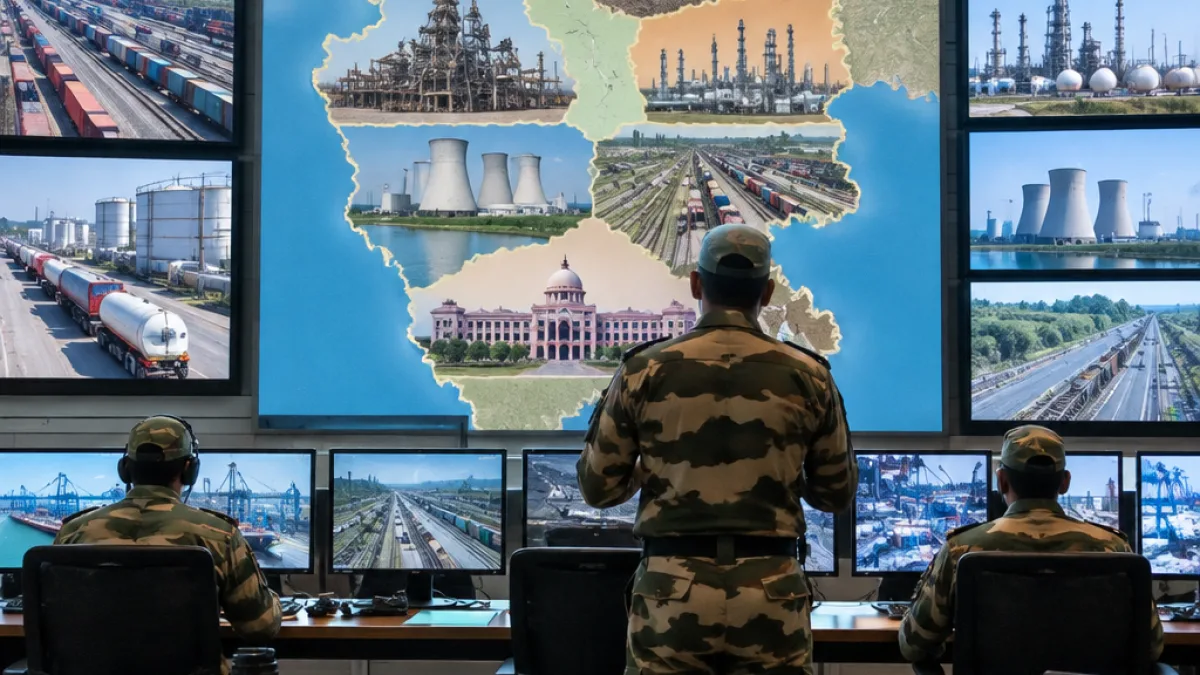
The force said the restructuring reflects a shift in the way security responsibilities are organised. Its stated principle is that command arrangements should consider not only where an installation is located, but also what it does and the consequences of its disruption. That approach places ports, energy facilities, industrial assets, government premises and mass transit infrastructure within more clearly defined functional chains of command.
Space installations, atomic energy facilities and airports had already operated under dedicated single commands and were described as exceptions to the earlier territorial system. The latest changes extend the functional-sector approach to additional categories of strategic and economic infrastructure, including the country’s seaports on both coasts.
The CISF described the move as a strategic reset intended to strengthen national security and preparedness while securing infrastructure linked to the vision of a Viksit Bharat. The announcement establishes the new sector structure and its areas of responsibility; it does not provide details of any change in the force’s sanctioned strength or deployment numbers.