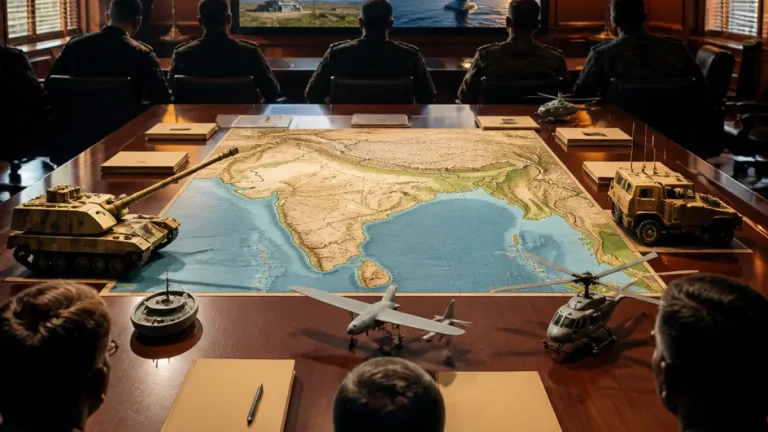
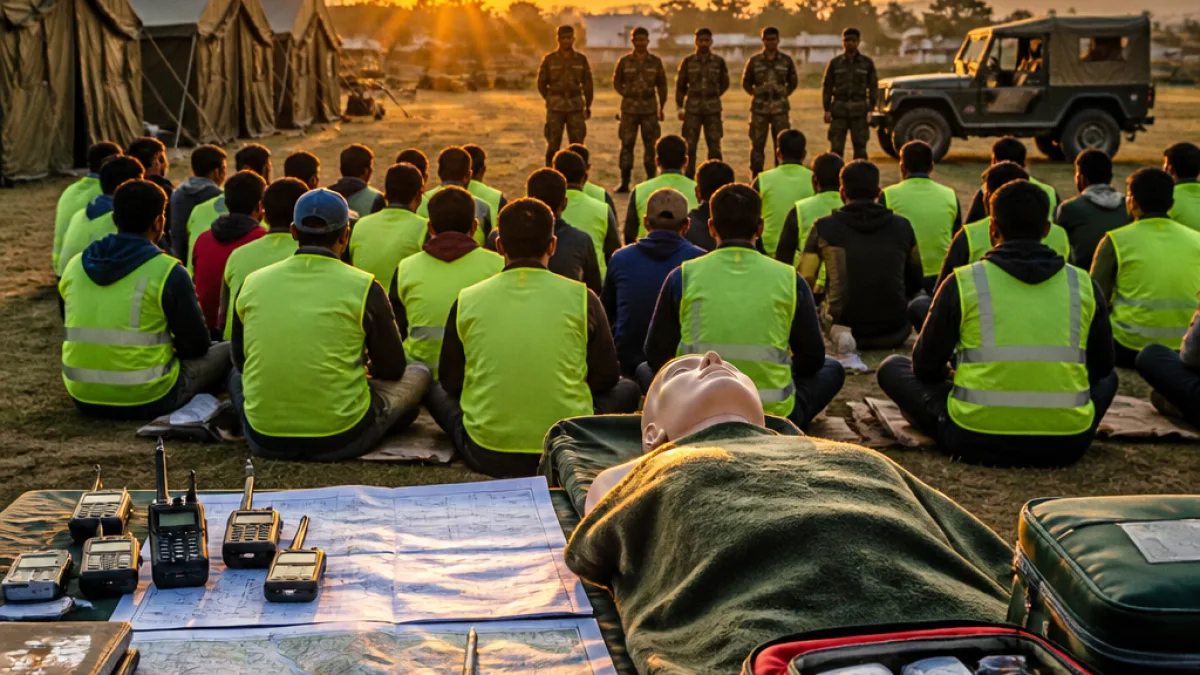
The Ministry of Home Affairs has initiated a pilot to strengthen civil defence preparedness by engaging the Indian Army to provide specialised training to civil defence personnel. The drive will train a total of 600 Civil Defence Master Trainers, with 50 trainees from each of the participating States and Union Territories, the Ministry said on 23 October 2026.
“In furtherance of this vision, the Directorate General of Fire Services, Civil Defence & Home Guards (DGFSCDHG), the Ministry of Home Affairs, in coordination with the Indian Army, is undertaking a first‑of‑its‑kind pilot initiative to strengthen civil defence preparedness through specialised training of ‘Civil Defence Master Trainers’ by the Indian Army,” the Ministry of Home Affairs said.
The three‑day residential courses are scheduled to be held at designated Indian Army training establishments in the second week of November 2026 as part of the first phase. Personnel from Jammu & Kashmir, Punjab, Rajasthan, Gujarat, Delhi, Meghalaya, Sikkim, Assam, Uttar Pradesh, Kerala, Karnataka and Tamil Nadu will participate.
Training modules and scope
The Ministry described the syllabus as organised into three broad pillars. These are:
- Threat awareness — including modern and hybrid warfare, drone awareness and air‑raid threats;
- Protection and emergency response — covering critical infrastructure protection, fire safety, chemical, biological, radiological and nuclear (CBRN) awareness, casualty management and search and rescue;
- Communication and coordination — emergency communications, cyber hygiene, digital resilience, civil‑military coordination and incident command.
The training is presented as the first phase of a bigger plan Prime Minister Narendra Modi announced in August to create a nationwide Civil Defence Network equipped with modern systems and technologies to respond to emerging security challenges. The MHA framed the pilot as a means to build a cadre of master trainers who can cascade skills to state and local civil defence formations.
Operational and institutional context
The Directorate General of Fire Services, Civil Defence & Home Guards (DGFSCDHG) under the Ministry of Home Affairs is leading the programme in coordination with the Indian Army. The selection of 12 States/UTs in the first phase spans northern, western, eastern, southern and northeastern regions, reflecting an effort to create geographically distributed training nodes.
| Item | Detail |
|---|---|
| Number of Master Trainers | 600 (50 per State/UT) |
| Participating States/UTs | Jammu & Kashmir, Punjab, Rajasthan, Gujarat, Delhi, Meghalaya, Sikkim, Assam, Uttar Pradesh, Kerala, Karnataka, Tamil Nadu |
| Training duration | Three days (second week of November 2026) |
| Lead agencies | DGFSCDHG, Ministry of Home Affairs; Indian Army |
The Ministry said the initiative aims to raise the capacity of civil defence units to respond to contemporary threats, including hybrid and non‑kinetic challenges. The Army will provide the specialised instruction at its training establishments; following the master trainer courses, the plan is for the trained personnel to impart knowledge within their respective State/UT civil defence structures.
The MHA framed the pilot as a step towards building contemporary preparedness capabilities to deal with emergencies and hostile situations. It did not publish details of which specific Army training centres will host the courses or the identities of instructors. The announcement confined itself to the numbers, participating States/UTs and the thematic content of the modules.
Officials at the DGFSCDHG and the Indian Army were not quoted beyond the Ministry statement. The programme joins a broader national emphasis on integrating civil and military preparedness for disaster, CBRN and emerging security risks, the Ministry said.