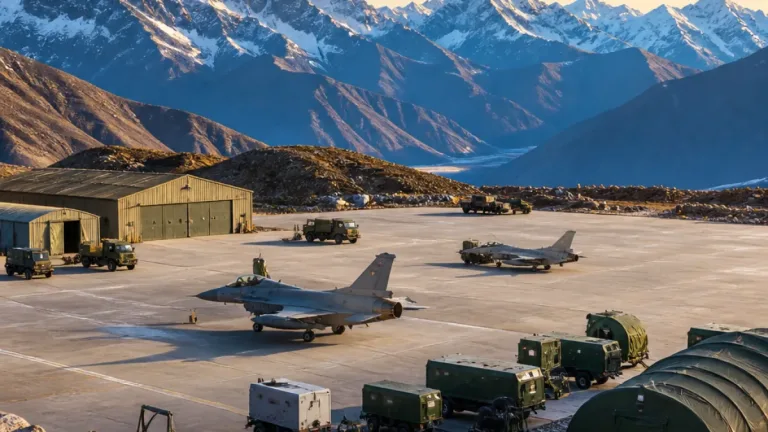

China on 26 October 2026 said it was “strictly abiding” by the agreements and common understandings reached with India while conducting normal border patrols to defend its territorial sovereignty, remarks that came after New Delhi said the Line of Actual Control (LAC) was periodically disturbed when Chinese forces deviated from established patrolling patterns.
What Beijing told reporters
Chinese Foreign Ministry spokesperson Guo Jiakun made the comments at a media briefing when asked about a statement by India’s Ministry of External Affairs that the situation along the LAC was disturbed from time to time because of patrolling deviations by Chinese forces. Guo said China and India kept communication open through diplomatic and military channels and called on India to implement the common understandings with concrete actions.
“China strictly abides by the relevant agreements and common understandings reached between the two countries, and conducts normal border patrol and control activities to safeguard its territorial sovereignty and stability in the border areas,” Guo Jiakun said.
India’s response and the operational context
India’s Ministry of External Affairs, through spokesperson Randhir Jaiswal, had said the situation along the LAC was disturbed from time to time when Chinese forces deviated from established patrolling patterns. Jaiswal reiterated that both sides continued to use diplomatic and military mechanisms to resolve outstanding issues and avoid misunderstanding and miscalculation along the Line of Actual Control.
The MEA comments followed public remarks by the Indo‑Tibetan Border Police (ITBP) Director General Shatrujeet Singh Kapur, who acknowledged at the ITBP’s annual Himveer Samman ceremony on 22 October that face‑offs with Chinese troops had occurred at several locations in Arunachal Pradesh and were continuing. Kapur also highlighted the role of newly raised Shaurya commando teams in recent face‑offs.
- China: called for joint implementation of agreements and said it conducts normal border patrols (statement by Guo Jiakun, 26 October 2026).
- India (MEA): said LAC situation is disturbed when Chinese forces diverge from established patrolling patterns (statement by Randhir Jaiswal, week of 23 October 2026).
- ITBP: DG Shatrujeet Singh Kapur publicly acknowledged recent and continuing face‑offs in Arunachal Pradesh (remarks on 22 October 2026).
What this means for border management
Both New Delhi and Beijing publicly emphasised ongoing use of diplomatic and military channels to manage the frontier. The two statements underline a recurring challenge: while both sides cite existing mechanisms and understandings, they continue to characterise the cause of friction differently—India pointing to patrolling deviations and China describing its actions as normal patrols implemented under bilateral accords.
| party | public position (as stated) |
|---|---|
| China (Foreign Ministry) | Strictly abiding by agreements; conducting normal patrols to safeguard sovereignty (Guo Jiakun, 26 October 2026) |
| India (MEA) | Situation disturbed when Chinese forces diverge from established patrolling patterns; diplomatic and military mechanisms remain in use (Randhir Jaiswal, week of 23 October 2026) |
| ITBP | Face‑offs have occurred at several locations in Arunachal Pradesh and continue; Shaurya commando teams deployed (DG Shatrujeet Singh Kapur, 22 October 2026) |
The public exchange comes amid efforts by both countries to rebuild bilateral relations after the 2020 Galwan Valley clashes and the subsequent multi‑year face‑off. While New Delhi and Beijing routinely cite established mechanisms to de‑escalate and clarify the LAC, the latest statements show that tactical differences in interpreting patrol lines and movements continue to produce friction on the ground.