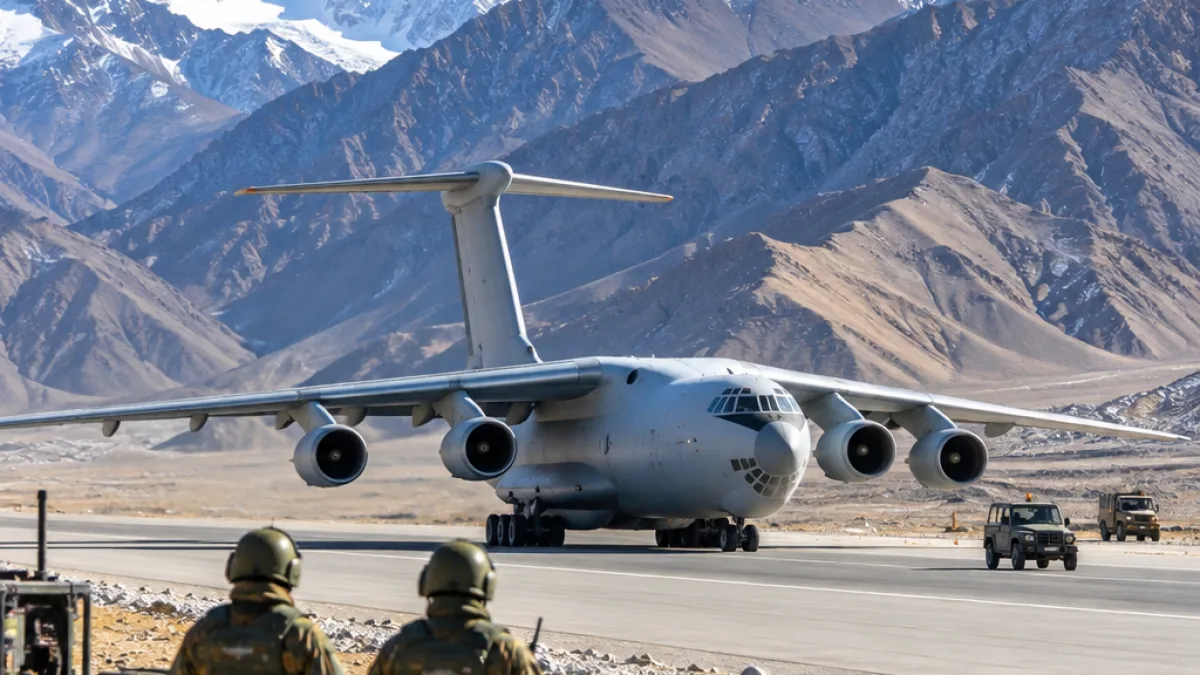
The Indian Air Force’s landing of an IL-76 strategic airlifter at Nyoma in Ladakh, announced on 7 November, has highlighted a major change in India’s ability to support forces near the Line of Actual Control with China. The airfield allows troops, tanks, artillery and supplies to be flown much closer to the frontier than before, reducing the dependence on long road movements from Leh or Thoise.
Until now, heavy equipment and personnel intended for the Ladakh sector had to be transported through those air bases before being moved by road over high passes. Nyoma is more than 200 km closer to the forward areas than those locations, according to the account of the landing. The principal significance is therefore not only the amount of cargo an IL-76 can carry, but the fact that such an aircraft can operate from a high-altitude airfield so close to the LAC.
High-altitude operations impose severe limits
Operating aircraft at Nyoma presents demanding technical conditions. Thin air at high altitude reduces engine thrust and wing lift, requiring longer runways and limiting the payload that aircraft can carry. The IL-76 may lose almost half its payload in such conditions, making the successful landing an important demonstration of access rather than a guarantee that the aircraft can move its maximum load on every sortie.
In their present condition, the higher airstrips at Daulat Beg Oldi and Fukche cannot receive strategic airlifters such as the IL-76 or the C-17. Nyoma has consequently become the most forward base in Ladakh along the LAC that can accommodate these aircraft, according to the report. The landing ground was constructed during the 1962 war and remained largely unused for decades before being upgraded by the Border Roads Organisation at a cost of ₹218 crore.
| Nyoma airfield | Details |
|---|---|
| Aircraft demonstrated | IL-76 |
| Upgrade agency | Border Roads Organisation |
| Upgrade cost | ₹218 crore |
| Operational status | Became operational in November 2025 |
From emergency reinforcement to sustained logistics
The airfield’s importance is linked to the scale of the military mobilisation during the 2020 Galwan crisis. During that period, the IAF airlifted more than 68,000 troops, 90 tanks and 330 infantry combat vehicles into Ladakh. The role of airlift has since moved beyond the immediate movement of reinforcements. At super-high altitudes, the continuing requirement is to sustain a large force through successive winters, when road access and movement over high passes are especially difficult.
The development also comes against the backdrop of China’s expanding aviation infrastructure in Tibet. The US think tank CSIS has assessed that all five existing airports in Tibet, each with dual-use potential, have been upgraded. It has also identified new facilities at Lhuntse, Ngari-Burang and Shigatse-Tingri, all less than 60 km from the border.
- Shigatse has a runway measuring 5,000 metres.
- Qamdo-Bamda has a runway measuring 5,500 metres.
- Lhasa had added a runway and at least 30 hardened aircraft shelters by 2023.
- Lhunze was reported to have 36 hardened shelters by late 2025.
The same assessment underlines the air-power imbalance facing India along the frontier. China’s J-20 stealth fighter entered service in 2017, making China the third country to operate an operational stealth fighter, while independent estimates place the Chinese fleet at between 300 and 500 aircraft. India has no such aircraft, according to the report.
Nyoma does not remove the payload penalties imposed by altitude, nor does it replace the need for road-based logistics. Its significance lies in giving the IAF a forward airlift point from which personnel, equipment and supplies can be moved closer to the LAC. That shortens the distance between air delivery and the frontline, while providing India with a more direct means of maintaining forces deployed in one of the country’s most difficult military environments.