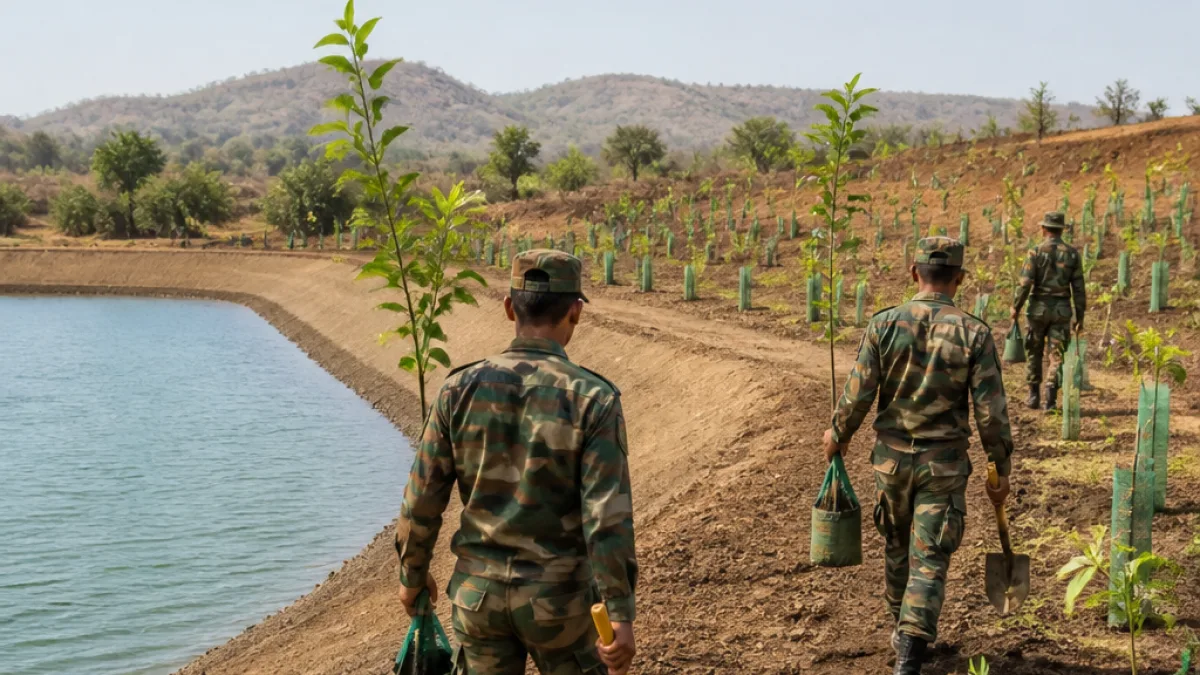
The Territorial Army’s ecological unit in Maharashtra has accelerated conservation works across Marathwada as the region struggles with a significant rainfall deficit and stressed water resources. The 136 Infantry Battalion (Territorial Army) Eco Mahar — known locally as the Marathwada Eco Warriors — says it has developed 19 water reservoirs with a combined storage capacity of 14.7 crore litres, planted more than 29 lakh saplings and restored about 2,190 hectares of degraded land.
Why the effort matters in Marathwada
Officials described the programme as a multi‑pronged attempt to retain rainwater, recharge aquifers and improve the ecological health of landscape patches where agriculture and drinking water are under pressure. The work has been concentrated in forest pockets across Chhatrapati Sambhajinagar, Beed and Hingoli districts, the battalion said.
“The overall moisture level in the surrounding areas is better than the other villages in the region. These water reservoirs are in the forest pockets in Chhatrapati Sambhajinagar, Beed and Hingoli district,” a senior army officer said.
The battalion framed its activities against deteriorating seasonal indicators presented by civil authorities. A presentation by divisional commissioner G Shreekant to a central drought assessment team reported Marathwada had received only 65.35% of average seasonal rainfall. Reservoir storage across the region had fallen to 30.7% of capacity and groundwater in Jalna, Dharashiv and Latur was 4 to 5 metres below the five‑year average, the presentation said.
What the battalion is doing on the ground
- Constructing and restoring local water storage structures to capture monsoon runoff and provide buffer storage for dry periods
- Large‑scale plantation drives — more than 29 lakh saplings planted — to stabilise soil and improve moisture retention
- Land restoration measures across about 2,190 hectares to reduce erosion and encourage groundwater percolation
A senior army officer told reporters the reservoirs aim to hold rain that would otherwise run off, helping recharge groundwater and provide stored water for domestic and livestock needs during dry spells. The battalion stressed its approach combines engineering measures with vegetation restoration rather than focusing solely on tree planting or individual structures.
| Item | Figure |
|---|---|
| Water reservoirs built | 19 |
| Total storage capacity | 14.7 crore litres |
| Saplings planted | 29 lakh+ |
| Land restored | 2,190 hectares |
The battalion's statement located the work within a larger drought response as farmers face crop damage from a weak monsoon and local authorities plan for the upcoming rabi season. The Territorial Army described the effort as conservation‑oriented, aimed at both immediate water retention and longer‑term ecological restoration.