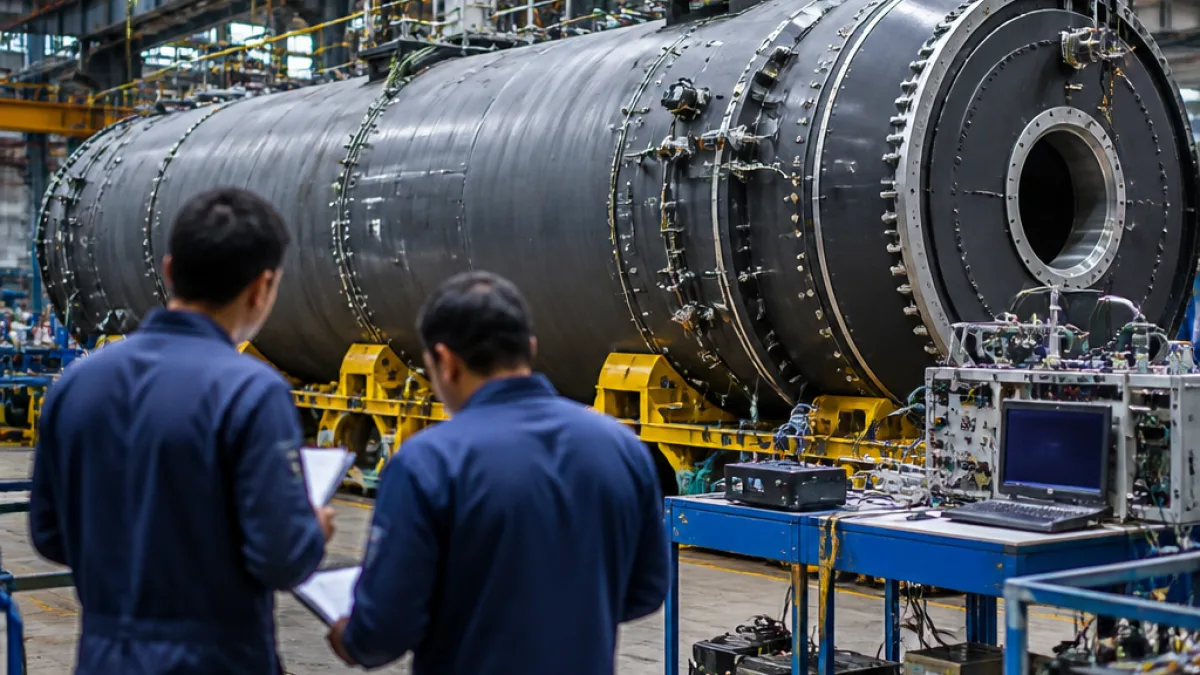
The Defence Research and Development Organisation’s Naval Materials Research Laboratory has advanced work on an indigenous Air Independent Propulsion (AIP) energy module for diesel‑electric submarines by inaugurating the Setting to Work Phase 2 at a heavy‑engineering complex in Hazira, Gujarat, on 24 October. The activity moves the research module into an industrial environment ahead of power production tests and formal navy trials.
What the phase means
Officials described the Hazira work as a controlled manufacturing milestone rather than a declaration of operational readiness. The module’s transfer to an industrial shop floor marks the transition from laboratory research to staged industrial processes, but it does not substitute for the Indian Navy’s separate technical assessment that will determine whether the unit may be accepted for integration.
- Developer: Naval Materials Research Laboratory (DRDO)
- Site for Phase 2: heavy‑engineering complex, Hazira, Gujarat
- Next technical steps: energisation for power production; Indian Navy testing; potential handover to Mazagon Dock Shipbuilders Limited
Planned route to integration
According to the programme timeline reported with the inauguration, the immediate next activity is to energise the module to produce power. That will be followed by a series of tests conducted under the Indian Navy’s procedures. Only after those tests is the module expected to be handed over to Mazagon Dock Shipbuilders Limited for integration with a Kalvari‑class submarine; that integration step is planned for early 2027.
| stage | status |
|---|---|
| Laboratory development | completed (research module) |
| Setting to Work Phase 2 (industrial) | underway at Hazira (24 October) |
| Energisation and power production tests | next |
| Indian Navy testing and technical assessment | planned after energisation |
| Handover for submarine integration | scheduled to Mazagon Dock for early 2027 |
Air Independent Propulsion systems are intended to reduce a diesel‑electric submarine’s dependence on atmospheric oxygen and thereby extend underwater endurance; the Hazira works form part of the stepwise development sequence required before any sea trials or fleet employment. The inauguration underlines collaboration between a DRDO laboratory, an industrial heavy‑engineering site, the naval customer and the shipbuilder that will carry out integration.
Those involved emphasise that the current stage is a manufacturing and testing milestone, not an announcement of a completed AIP‑equipped boat or proven at‑sea endurance gain. The programme retains multiple defined stages ahead, with operational acceptance contingent on the formal assessments and tests the Indian Navy will conduct.